Posts

Patrimonial Capitalism

Image
This notion has been stewing in me for quite a while, and yesterday Paul Krugman wrote an article about this topic of Patrimonial Capitalism . " ...the political spectrum now instinctively accords much more respect to capital than to labor, at a time when capital income is growing ever more concentrated in a few hands — and is surely on its way to being concentrated largely in the hands of people who inherited their wealth." This is somewhat related to my earlier post of how I wish things were - with a balance between owners, employees and customers - called Capitalism and the Three Legged Stool . In Krugman's article, the basic premise is that since wealth and income are concentrated increasingly in fewer people's hands, the society at large is dependent on the patrimony, or direction, of the 1% (or maybe the .1%).  Decisions like Citizens United help to reconfirm this, as those with large wealth can now invest to shape the government. These topics have b...

WhatsApp Valuation Model

Image
I finally had a moment to figure out the Whatsapp business model. First year is free and then $0.99 per year thereafter . With 400 Million users, that is about $400M in revenue per year (or per next year).  They do 18 Billion messages per day. Using Amazon AWS SQS or SNS pricing of $0.50 per Million, that is $9,000 per day of approximate cost, or about $4M of costs per year. I know that is probably a bit light because I am not including data transfer costs of about a Nickel/GB.  For employee costs, they had about 60 people at an average fully burdened load of $200K is about $11M. The big cost for WhatsApp are the Apple and Android Store transaction fees of 30% - about $120M. So, a net income (next) year of ~$260M.  Put that net at a 73X P/E ratio and it gets you to the $19B valuation.  Comparatively: IBM has a PE of 12 Red Hat has a PE of 64 Facebook has a PE of 112 Amazon has a PE of 580. Of course it positions Facebook well to address some challen...

Capitalism vs. the Three Legged Stool

Image
Wikipedia defines: " Capitalism  is an  economic system  in which trade, industry and the  means of production  are controlled by private owners with the goal of making  profits  in a  market economy ." This definition has always bothered me. I prefer a different model where there is equal recognition of the three primary drivers behind the success of a company: Owners Employees Customers I like to think of it as a three legged stool, where each leg is as important as the other.  One gets too large or small and the stool tips over. The free market is supposed to take care of Employees and Customers.  Employees because the Owners will create so many jobs that due to supply and demand, employees will receive competitive pay.  Customers because if the owners are not building the right thing, then they can go elsewhere. As someone who has helped to build about 10 startup companies now, I have seen the power in mak...

Options

Image
Alex McCaw wrote an excellent blog explaining stock options - http://blog.alexmaccaw.com/an-engineers-guide-to-stock-options .  Everyone getting options (an engineer or not) should read this - especially the tax implications of converting your options. I thought there were several common issues that could use some further explanation using an example. For our example, lets say a VC investment made of $10 M at a valuation of $50M. Pre Money and Post Money Valuation.  Since people like big numbers, so this is usually expressed as post-money. So the company was valued at $40M before the investment, but now that they have another $10M in the bank, they are now worth $50M. Dilution.  Before the investment there were 4,000 shares/options, each worth $10, and each representing 1/4,000th of the company.  For the investment another 1,000 shares were created and sold to the investors at $10 each.  Each share/option each employee had was worth $10 before an...

JBoss Recollections - Part 5 - The Business Team

Image
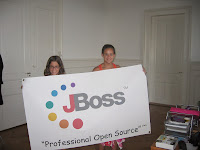
My daughters, Mollie and Allison, in Neuchatel, Switzerland waving the JBoss flag I have covered other JBoss Recollections previously: 1. Early Years , 2. Forming the Strategy , 3. Tech Team , and 4. VC Funding . Of course any real business needs business people to drive success and growth. Here were the key hires by date and some stories behind each. Looking back, I still think we made the right decisions on each of these great people as well as the timing and order of their hiring. That was one of the many lucky things that happened to make JBoss successful. Marc and Ben Ben Sabrin - 2001 - Ben was at JBoss before I got there. I've talked about Ben in the earlier recollections, but I would be remiss to not mention his significant contributions to JBoss. He figured out that customers wanted to buy from JBoss before almost anyone. Tom Leonard - 12/03 - I knew that the key thing about making JBoss successful as a business was credibility. And there were two major way...

KK, Jenkins and the Triumph of Technology

Image
Kohsuke Kawaguchi is the most brilliant developer and creator I have gotten the chance to work with (we work together at CloudBees). I just got back from the Jenkins Users Conference , where 450 people from around the world (literally) attended and another 500+ watched via live video stream. In his keynote, KK reviewed his concerns with having created Jenkins.  (It is the defacto "Continuous Integration Server".  Many, many companies use it to "build, test and deploy" their software - meaning it winds up being the glue that glues the pieces together of many of the applications people use today like Yahoo, Netflix, EBay, Amazon Kindle, cell phones, etc. Not to mention big companies like Cisco, AMEX, Macy's, Nordstrom and literally tens of thousands of others.) To "build, test and deploy" all of these applications, he estimates it takes 3 Facebook sized data centers running pretty much full time 24 hours a day, 7 days a week, 365 days a year...

Venture Funded vs. "Lifestyle" Startups

Image
I get pinged a couple of times per week by people about starting up a business.  Almost always the question is "How do I get funded". My common answer is take money when you don't need it, because that is the only time when people will want to give it to you. And don't take money when you need it, because people won't want to give it to you then. Why I was a Fan of VC Funding Here is an example story. In 1994 Bluestone had created a tool that made it easy to develop applications for the web that were driven from a database.  Today this is how all websites work, but it was the early days.  We were funding the development ourselves out of cash flow, and investors approached us - Bessemer actually gave us a term sheet. The founder declined.  Our competitors (Spider Technology, which became NetDynamics) got funding and we were forced to respond to match their higher levels of spending and go look for venture funds.  Of course when we did, our final term sheet...